The Ecological Umbrella: Pitons Management Area
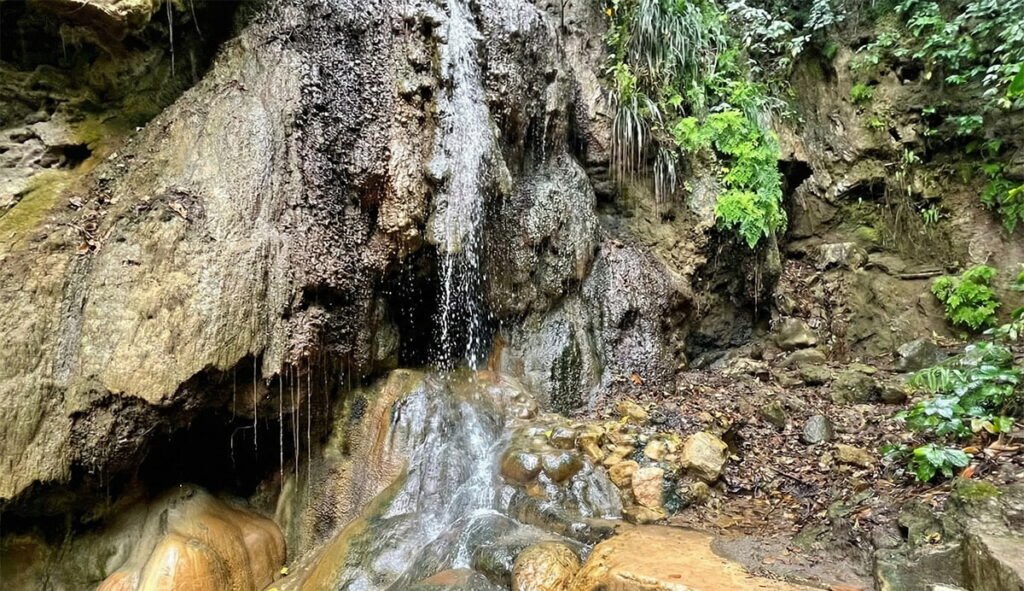
Piton Falls is not merely a destination for leisure; it is a critical hydro-geological discharge point within the Pitons Management Area (PMA). Situated on the leeward slopes of the Soufrière volcanic center, this 2,909-hectare region represents a complex intersection of geothermal activity and tropical biodiversity. The falls function as a natural overflow for the Qualibou Caldera, where the subsurface heat from the volcanic center warms the groundwater before it emerges at the base of Petit Piton.
Conservation here is governed by a delicate thermal balance. Because the falls are located at the epicenter of St. Lucia’s volcanic heritage, any alteration to the surrounding landscape—whether through development or deforestation—directly impacts the temperature and mineral consistency of the water. For those planning a visit, understanding this environmental context is essential, and you can find specific entry requirements on our Visitor Rules & Guidelines page.
The management of visitor sites within the PMA is overseen by the Soufrière Regional Development Foundation (SRDF), which coordinates with the Government of Saint Lucia [Official Website] to ensure that tourism revenue is channeled back into trail maintenance and reforestation. This symbiotic relationship ensures that the high volume of visitors on a St. Lucia Land and Sea Tour does not degrade the very resource they come to see.
UNESCO World Heritage Designation (2004)
On June 30, 2004, the Pitons Management Area was officially inscribed as a UNESCO World Heritage site. This was not a purely symbolic gesture; the inscription was based on the area’s “Outstanding Universal Value,” a technical designation that identifies the Pitons and their associated mineral springs as irreplaceable global assets. The criteria for selection focused on the site’s exceptional natural beauty and its tectonic significance, showcasing the unique geological history of the Caribbean Plate.
The UNESCO status imposes a rigorous set of conservation standards. It mandates that the natural aesthetic of the Petit Piton base remains intact, limiting the type of infrastructure that can be built near the falls. This preservation effort is what allows the site to maintain its “natural massage” properties, which are explored in detail on our Therapeutic Mineral Waters guide. According to the UNESCO World Heritage Centre [Official Portal], the PMA is recognized for its zoning system that explicitly attempts to balance resource use with strict environmental protection.
Spatial Geography: Land vs. Sea Conservation
Effective conservation at Piton Falls requires a “ridge-to-reef” management approach. The 2,909 hectares of protected territory are not uniform; they are divided into terrestrial and marine zones that interact through the island’s hydrological cycle. Runoff from the mineral-rich slopes travels through the local coastal ravine system, eventually reaching the Marine Management Area (SMMA). This connectivity means that any solid waste or chemical pollutants introduced at the waterfall can potentially damage the coral reefs located just a few hundred yards downstream.
| Zone Type | Area (Hectares) | Primary Conservation Focus |
|---|---|---|
| Total Protected Territory | 2,909 ha | Unified Management Umbrella |
| Terrestrial Conservation | 467 ha | Forestry, Volcanic Peaks & Ridge |
| Marine Management Area | 875 ha | Coral Reefs & Coastal Connectivity |
| Terrestrial Multiple Use | 1,567 ha | Piton Falls, Geothermal & Agriculture |
The 1,567 hectares of the Multiple Use Area encompass a variety of microclimates, from dry leeward forest to moist tropical rainforest. Piton Falls sits within this transition zone, where the mineral deposits interact with the local flora to create a unique riparian ecosystem. Many travelers who visit via a Sightseeing Cruise with Snorkeling often miss this upland connectivity, yet the health of the snorkeling sites depends entirely on the conservation efforts practiced at the falls.
Statutory Instrument No. 107 of 2024: A Legal Milestone
The legal framework for protecting Piton Falls underwent a radical transformation in July 2024. With the passage of Statutory Instrument No. 107 of 2024, the Pitons Management Area was formally declared an Environmental Protection Area (EPA). This move moved the PMA’s status from a managed district to a legally enforced zone under the Physical Planning Act. This provides the Piton Management Area Office and the Department of Physical Planning with the “teeth” necessary to prosecute environmental violations.
This legislation is particularly relevant for the “Limits of Acceptable Change” (LAC) framework. For years, LAC recommendations were viewed as advisory; however, the 2024 law makes these mandates legally binding for all site developments. This includes restrictions on visitor density in staging areas and the types of materials used in trail construction. If you are curious about the logistics of reaching this protected zone, please consult our How to Get to Piton Falls guide for information on parking and access routes.
The ‘Limits of Acceptable Change’ (LAC) framework is no longer just a recommendation; as of July 2024, it is a legally binding mandate that dictates how many visitors and what level of development the Piton Falls ecosystem can sustainably handle.
Department of Sustainable Development, St. Lucia
Current Conservation Outlook: The 2025 IUCN Assessment
Despite the legal advancements, the IUCN World Heritage Outlook 2025 assessment classifies the Pitons Management Area as being of “High Concern.” This classification is largely driven by the complexities of land ownership. Approximately 80% of the land within the PMA is privately owned, which complicates the implementation of a centralized conservation strategy. While the falls themselves are managed for public access, the surrounding slopes are a patchwork of private estates, some of which face pressure for residential development.
The 2025 report also identifies climate-induced changes in rainfall patterns as a significant threat. Reduced rainfall can lead to higher mineral concentrations and increased water temperatures at the falls, potentially exceeding the comfortable 30°C to 38°C (86°F–100°F) range. This thermal volatility is why visitors are often advised to visit during the morning hours, a tip also highlighted in our Plan Your Visit resource. The IUCN assessment emphasizes that the survival of the site depends on community-led initiatives like the “Flowing Clean” project.
The “Flowing Clean” Initiative & Endemic Flora
Launched on June 5, 2025 (World Environment Day), the “Flowing Clean” initiative is a strategic effort to restore the Soufrière River system. This project focuses on the riparian zones surrounding local waterfalls, including Piton Falls and the nearby Superman Falls. By removing solid waste and invasive species from the riverbanks, the project aims to stabilize the soil and prevent siltation of the mineral pools.
- Vetiver Grass Stabilization: Trail maintenance at Piton Falls utilizes Chrysopogon zizanioides (Vetiver grass). This sterile perennial has roots that reach up to 15 feet deep, providing bio-engineered slope stabilization without introducing invasive seeds. Learn more about this technique from the Caribbean Climate Hub [Official].
- Acalypha elizabethiae Monitoring: This rare endemic shrub thrives on the semi-open leeward slopes near the falls. Rangers monitor its growth patterns as an indicator of the overall health of the forest canopy.
- The Quassia Tree: The surrounding rainforest contains the indigenous Bitter Bark (Quassia) tree. Historically used in medicinal teas, its presence signifies a mature, well-preserved ecosystem.
- Iron Oxide Dominance: Unlike the high-sulfur content of the “Drive-In Volcano,” Piton Falls is dominated by Iron Oxide, which creates the distinct orange-red mineral staining on the cliff face. Technical data on these deposits can be found at the UWI Seismic Research Centre [Official].
Sustainable Visitation: How You Can Help
Preservation is a collective effort. A small entry fee (typically around $3 USD, cash only) contributes directly to the maintenance of the falls, mineral pools, and surrounding gardens. While this site does not require the extensive ranger patrols found on the Gros Piton hikes, your physical impact on this sensitive geothermal area is still significant. To ensure a respectful visit and gain deeper insight into St. Lucia’s ecology, you might consider a Private Island Tour with a knowledgeable local guide.
Mineral-Safe Practices
The mineral-rich waters of Piton Falls eventually flow into the Caribbean Sea, where chemical pollutants can impact delicate coral reefs. To protect this ecosystem, visitors are encouraged to rinse off before entering the pools and to use only biodegradable, reef-safe products. This supports the broader conservation efforts of the Pitons Management Area, a designated UNESCO World Heritage site.
Path Integrity
Staying on designated walkways is not just a safety rule; it is a conservation necessity. The soil at the base of Petit Piton is highly susceptible to erosion. Straying from the path crushes the delicate root systems of the Acalypha elizabethiae and contributes to the siltation of the mineral pools. For those interested in seeing more of the region’s flora, the Belle Vue District offers additional trails designed for low-impact exploration.
By respecting the 2024 legal updates and adhering to the guidelines set by the Soufrière Foundation, you ensure that Piton Falls remains a pristine wellness destination for future generations. For more information on tickets and supporting these initiatives, visit our Tickets & Tours page.