St. Lucia Travel Safety: A Practical Guide
Exploring the rugged terrain of St. Lucia, particularly around the iconic Piton Falls, is an exercise in balancing adventure with practical awareness. The Soufrière region is defined by its dramatic verticality, where lush rainforests meet volcanic geothermal activity. While the vibe is one of deep relaxation—especially when standing under the 35°C mineral torrents—the island’s geography demands respect. Visitors should expect a sensory-rich experience where the smell of sulfur and the sound of tropical birds are matched by the physical challenge of navigating winding, narrow coastal roads.
Safety in St. Lucia is less about avoiding “danger zones” and more about understanding the local environment and infrastructure. The island’s pace is “island time,” but its nature is highly active, from flash-flood-prone districts to high-altitude ridges that catch heavy mist. By mastering the logistical nuances—like knowing the location of the newly reconstructed St. Jude Hospital (formerly operating out of a stadium) and how to read the color of a river—you transform from a vulnerable tourist into a confident traveler. This guide provides the “Golden Middle” of safety: enough detail to keep you secure without overwhelming your vacation spirit.
Navigating the Terrain: Road & Transport
The West Coast Hairpins
The drive from the capital, Castries, to the Soufrière area contains over 100 sharp hairpin turns. For the 2024/2025 season, the primary safety recommendation is to avoid driving this route for the first time after 6:00 PM. The lack of “cat’s eye” reflectors makes the steep drops and tight corners difficult to judge in the dark. If you are uncomfortable with steep gradients, consider booking private airport and hotel transfers to let a local professional handle the navigation.
- Road Conditions: Many sections of the road to the falls are narrow. Local drivers often use their horns as a warning before blind corners; you should do the same.
- Vehicle Choice: While a standard car can reach the falls, a 4WD provides better traction for the steep, often damp tracks in the Belle Vue district.
- The Barre de L’Isle Ridge: This high-altitude pass often collects heavy fog. If visibility drops, reduce speed significantly as the road surface can become slick with mountain mist.
Environmental Awareness: Sun, Water, and Volcanics
Hydration and UV Safety
Between 11:00 AM and 3:00 PM, the UV Index in Soufrière regularly reaches levels of 11 or 12. Because the mineral water at Piton Falls is clear, it does not provide the “natural sunblock” coating found at the Sulphur Springs mud baths. Reef-safe SPF 50+ is highly recommended to prevent severe burns. Heat exhaustion is the most common medical ailment for tourists on the island. Aim for 2 liters of water daily; while tap water is generally treated, bottled water is preferred by most visitors for taste.
The therapeutic mineral waters at the falls maintain a temperature of 32°C to 35°C (90°F–95°F). While safe for long soaks, the combination of heat and humidity can lead to rapid dehydration. Always carry a refillable flask during your waterfall circuit.
Flash Flood Warnings & Rainfall Safety
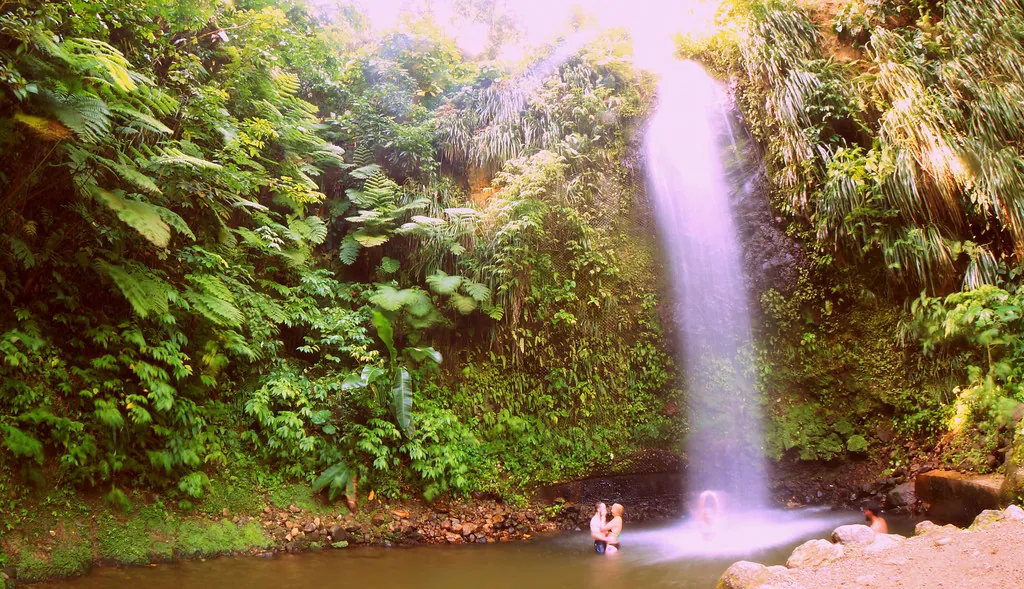
The Ministry of Health issues seasonal warnings regarding Leptospirosis, a bacterial risk in tropical freshwater. To mitigate this risk, avoid swimming in the falls or surrounding pools for 24–48 hours after heavy rainfall. This is particularly important in the Soufrière watershed where runoff is at its peak. Visitors should also learn to read the river: if the water at the falls turns from clear to an opaque brown or red, it indicates heavy upstream siltation and an imminent flash flood. Evacuate the pool area immediately if the color shifts. You can check the latest alerts at the Saint Lucia Meteorological Services [Official Website].
Personal Health & Security Protocol
Infrastructure & Medical Facilities
Should an emergency occur, knowing the current state of infrastructure is vital. The nearest medical facility to Piton Falls is St. Jude’s Hospital in Vieux Fort, located approximately 35 minutes away. As of 2025, it continues to operate out of the George Odlum Stadium while the main hospital undergoes reconstruction. For major surgical trauma, the Owen King EU (OKEU) Hospital in Castries is the island’s primary center. For more details on facility locations, refer to the transportation and logistics guide.
When parking at remote trailheads, follow the “Empty Glove Box” protocol. Leave the glove box open and empty to signal to potential thieves that no electronics or passports are stored inside. While Piton Falls has an attendant, this is a best practice for any solo exploration on customized island tours.
Practical Logistics for 2026
Before you depart, ensure you are familiar with the site-specific Visitor Rules & Guidelines. The entrance fee is currently $3 USD ($8 XCD). The 5 to 10-minute descent to Piton Falls involves approximately 40 hand-cut stone and dirt steps. Due to high humidity, the wooden handrails often develop a slick moss film by midday. Use a “three-point contact” grip during the descent to avoid slips. Once at the base, exercise extreme caution around the three warm mineral pools. The rocks surrounding these concrete basins are famously slippery due to the constant thermal moisture. Note that the site is not wheelchair accessible beyond the entrance gate. Payment is strictly cash-only. Bring exact change ($3 USD or $8 XCD) to minimize the time spent handling money at the trailhead. If you encounter “self-appointed guides” at the parking entrance offering to watch your car, a tip of $2–$5 USD ($5–$13 XCD) is the 2026 standard to ensure goodwill and vehicle security.
Essential Safety Contacts
| Service | Contact Number | Primary Location |
|---|---|---|
| Emergency (Police/Fire/Ambulance) | 911 | Island-wide |
| Soufrière Police Station | +1 758-456-3620 | Soufrière Town |
| St. Jude’s Hospital | +1 758-454-6041 | Vieux Fort |
| OKEU Hospital | +1 758-458-6500 | Castries |
For official travel advisories, consult the U.S. Department of State [Official Advisory] and the Royal Saint Lucia Police Force [Official Website].
Success in St. Lucia comes from preparation. By checking the weather, respecting the roads, and following local security protocols, you can focus on the scenic highlights and healing properties of the mineral springs. For further assistance in scheduling your visit, visit our Plan Your Visit resource page.